



Real-time financial data infrastructure is becoming increasingly important as fintech platforms, trading applications, digital banks, wealth-management products, and AI-powered financial tools need access to fresh information without building complex data pipelines from scratch.
Financial data can come from very different sources. Market-data providers stream prices, trades, quotes, and order-book information from exchanges, while open-finance platforms connect applications to bank accounts, balances, and transaction records. The infrastructure sitting between those sources and applications determines how quickly, reliably, and consistently financial information can be delivered.
This article looks at 10 companies building real-time financial data infrastructure across these two layers. Rather than focusing on giant financial institutions or household-name technology companies, the list focuses on specialized providers with developer APIs, streaming infrastructure, financial-data platforms, or connectivity technology at the center of their products.
Note: The companies below are not ranked by market capitalization or company size. They are selected based on their relevance to real-time financial data infrastructure, developer accessibility, data coverage, and the role their technology plays in modern financial applications.
What Is Real-Time Financial Data Infrastructure?
Real-time financial data infrastructure refers to the technology used to collect, normalize, process, stream, and distribute financial information with minimal delay.
Instead of connecting individually to dozens of exchanges, banks, or financial institutions, developers can use APIs and streaming services to access standardized data through a single integration. As the industry evolves, many of these firms are also looking at how top Indian companies building infrastructure are integrating these data streams into broader financial ecosystems.
This makes real-time financial data infrastructure an important layer underneath trading platforms, fintech applications, financial dashboards, portfolio-management systems, risk tools, and increasingly, AI-powered financial applications.
How We Selected These Financial Data Infrastructure Companies
The companies in this list were selected based on several practical factors:
- Real-time or near-real-time data capabilities
- API or WebSocket availability
- Breadth and quality of financial data
- Developer-oriented infrastructure
- Coverage across markets or financial institutions
- Ability to support production applications
- Relevance to fintech, trading, banking, or financial analytics
The list intentionally avoids companies such as Bloomberg, Microsoft, Visa, and other enormous global corporations whose broader businesses can overshadow their financial-data infrastructure offerings.
Top 10 companies building infrastructure for real-time financial data
1. Massive — Developer-First Market Data Infrastructure
Massive, formerly known as Polygon.io, is one of the more recognizable developer-focused companies in the modern market-data API ecosystem.
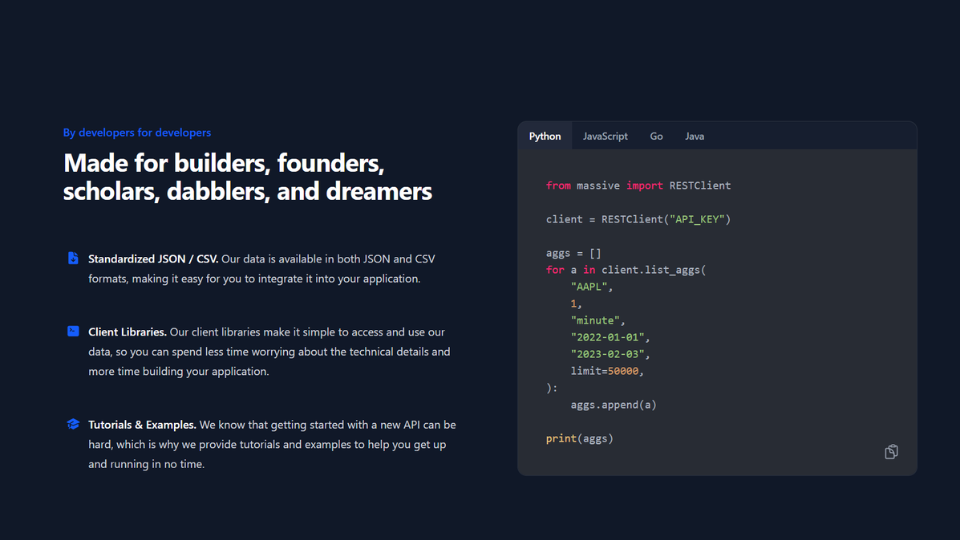
The company rebranded from Polygon.io to Massive in October 2025 while keeping its existing APIs, accounts, and integrations operational. Its platform provides programmatic access to financial market data across multiple asset classes.
Massive’s infrastructure covers stocks, options, forex, crypto, indices, and futures, with data delivered through REST APIs, WebSockets, and flat files. Its stock-data infrastructure is designed around feeds from U.S. exchanges and market-data consolidators, giving developers access to real-time trades, quotes, and other market events.
What makes Massive relevant?
The interesting part of Massive is its focus on turning traditionally complicated financial-market data into developer-accessible infrastructure. For those looking to expand into decentralized finance, following tips building crypto projects is often the next logical step after mastering market data.
Developers can use the platform for:
- Real-time stock prices
- Options data
- Forex data
- Cryptocurrency data
- Index data
- Futures data
- Historical market data
- WebSocket streaming
- Reference and company data
This makes Massive particularly relevant for fintech products that need live market information without building direct exchange connections themselves.
Best suited for: Trading applications, investment platforms, financial dashboards, market analytics, and developer-built financial products.
2. Databento — Exchange Data Built for Developers
Databento takes a more infrastructure-heavy approach to financial market data.
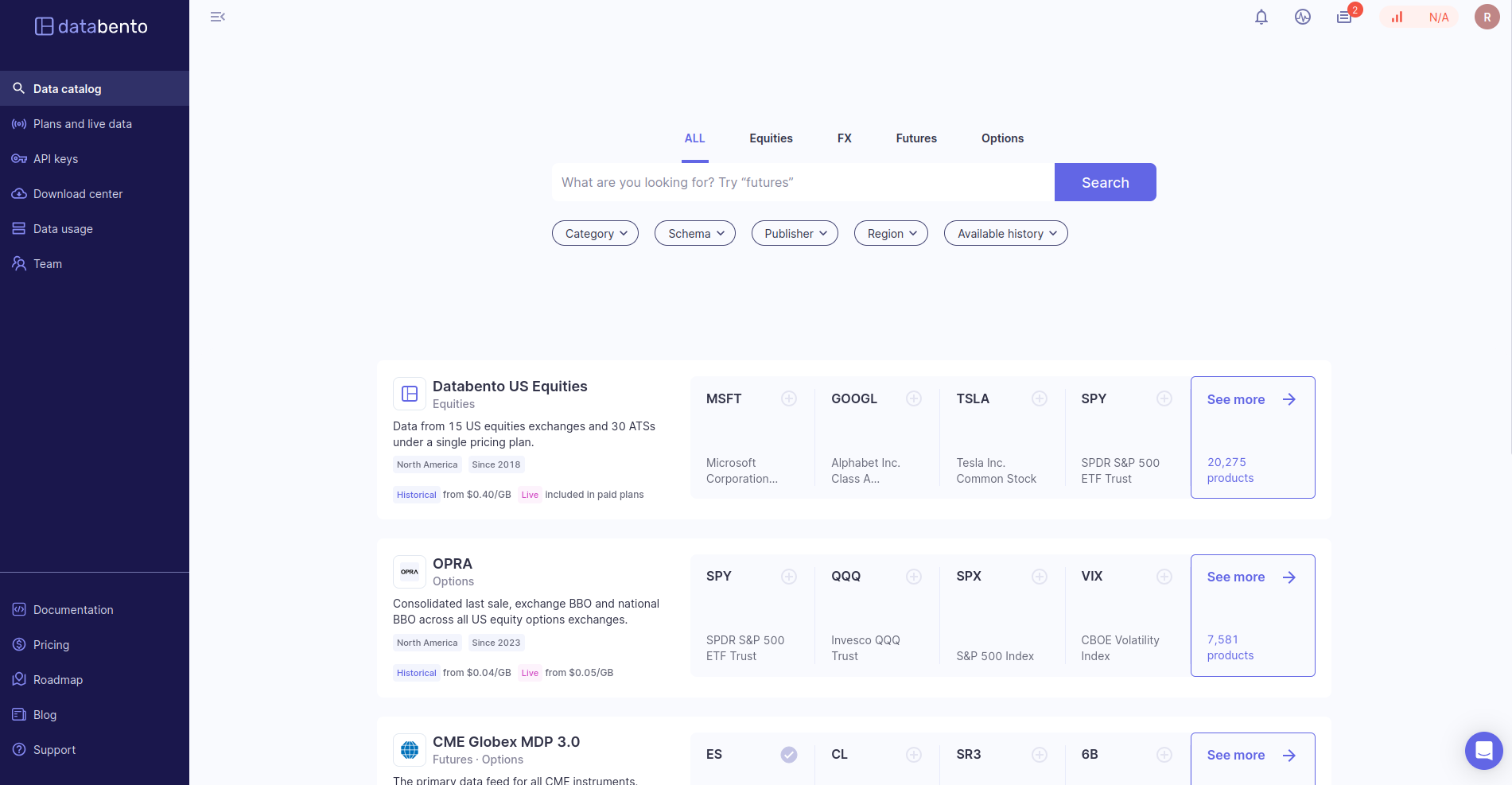
The company provides APIs for accessing live and historical market data, with its Live API using a socket-based subscription model for real-time feeds. Developers can subscribe to trades, aggregates, definitions, and other market-data schemas through a unified interface.
One of Databento’s notable characteristics is the relationship between its historical and live data systems. The same datasets, schemas, and symbology can be used across historical analysis and live applications, making it easier for developers to move from research and backtesting toward production systems.
Why Databento stands out
Financial-market data often becomes complicated because every venue can have different formats, identifiers, and data structures.
Databento attempts to standardize that experience.
Its infrastructure is particularly relevant to:
- Quantitative research
- Algorithmic trading
- Market-data pipelines
- Backtesting systems
- Trading analytics
- Financial machine learning
- Real-time monitoring
For teams that care about both historical depth and live market feeds, this unified approach can reduce the amount of custom data engineering required.
Best suited for: Quant teams, trading infrastructure, researchers, and developers working with exchange-level market data.
3. Twelve Data — Global Multi-Asset Financial Data APIs
Twelve Data focuses on making global financial market data accessible through a relatively unified developer experience.
Its platform provides APIs and WebSockets for stocks, forex, cryptocurrencies, ETFs, mutual funds, commodities, and other financial instruments. The company says its infrastructure covers U.S. exchanges, more than 90 international exchanges, and more than 180 cryptocurrency exchanges.
The platform is particularly interesting for applications that need data across multiple asset classes without maintaining separate integrations for every market.
Key capabilities
Twelve Data provides:
- REST APIs
- WebSocket streaming
- Historical data
- Real-time market data
- Reference data
- Technical indicators
- Multi-asset coverage
- SDK support
Its WebSocket infrastructure uses server-push delivery, allowing applications to receive information when new market data becomes available rather than repeatedly polling an endpoint.
That architecture can be useful for financial dashboards, portfolio applications, trading systems, and analytics products where continuously updated data is important.
Best suited for: Fintech developers, market-data applications, portfolio tools, and products requiring broad global asset coverage.
4. QUODD — Cloud-Native Market Data Infrastructure
QUODD occupies a more institutional part of the financial-data infrastructure market while maintaining a cloud-oriented delivery model.
Its platform provides real-time, delayed, historical, reference, fundamental, and point-in-time financial data across asset classes including equities, fixed income, derivatives, indices, FX, and crypto.
QUODD’s technology is built around its cloud-native infrastructure, with APIs, streaming delivery, data feeds, and other delivery mechanisms available to financial firms and technology platforms.
What QUODD provides
Its financial-data infrastructure can support:
- Real-time pricing
- Historical market data
- Security master data
- Fundamentals
- Corporate actions
- Reference data
- FX and derivatives data
- Streaming market feeds
- REST and gRPC APIs
The company also provides cloud streaming designed to deliver changing market values such as quotes, trades, bid/ask prices, and OHLC information directly to applications.
This makes QUODD particularly relevant for companies that need more than a simple stock-price API and instead require a broader financial-data layer.
Best suited for: Financial institutions, wealth platforms, market-data applications, and enterprise financial technology teams.
5. Intrinio — APIs for Real-Time Market and Financial Data
Intrinio has built its business around providing financial data through developer-friendly APIs and delivery methods.

Its platform covers areas such as stock prices, fundamentals, options, and other financial datasets, with REST APIs, WebSockets, and SDKs available for developers.
One of the company’s useful distinctions is between pulling financial information through Web APIs and streaming it continuously through WebSockets.
Intrinio specifically describes its WebSocket API as a way to stream the real-time price of a security continuously, while its Web API can be used for intraday, delayed, end-of-day, and real-time data depending on the dataset.
Where Intrinio fits
Intrinio can provide infrastructure for:
- Real-time stock prices
- Historical prices
- Financial statements
- Company fundamentals
- Options data
- Market research
- Financial applications
- Automated analytics
Its developer-oriented approach makes it an alternative for teams that want structured financial information without directly managing multiple market-data sources.
Best suited for: Developers, fintech startups, financial analysts, and applications combining market data with company fundamentals.
6. Tiingo — Low-Latency IEX Market Data Access
Tiingo focuses heavily on making market data accessible through APIs while maintaining a relatively developer-friendly interface.
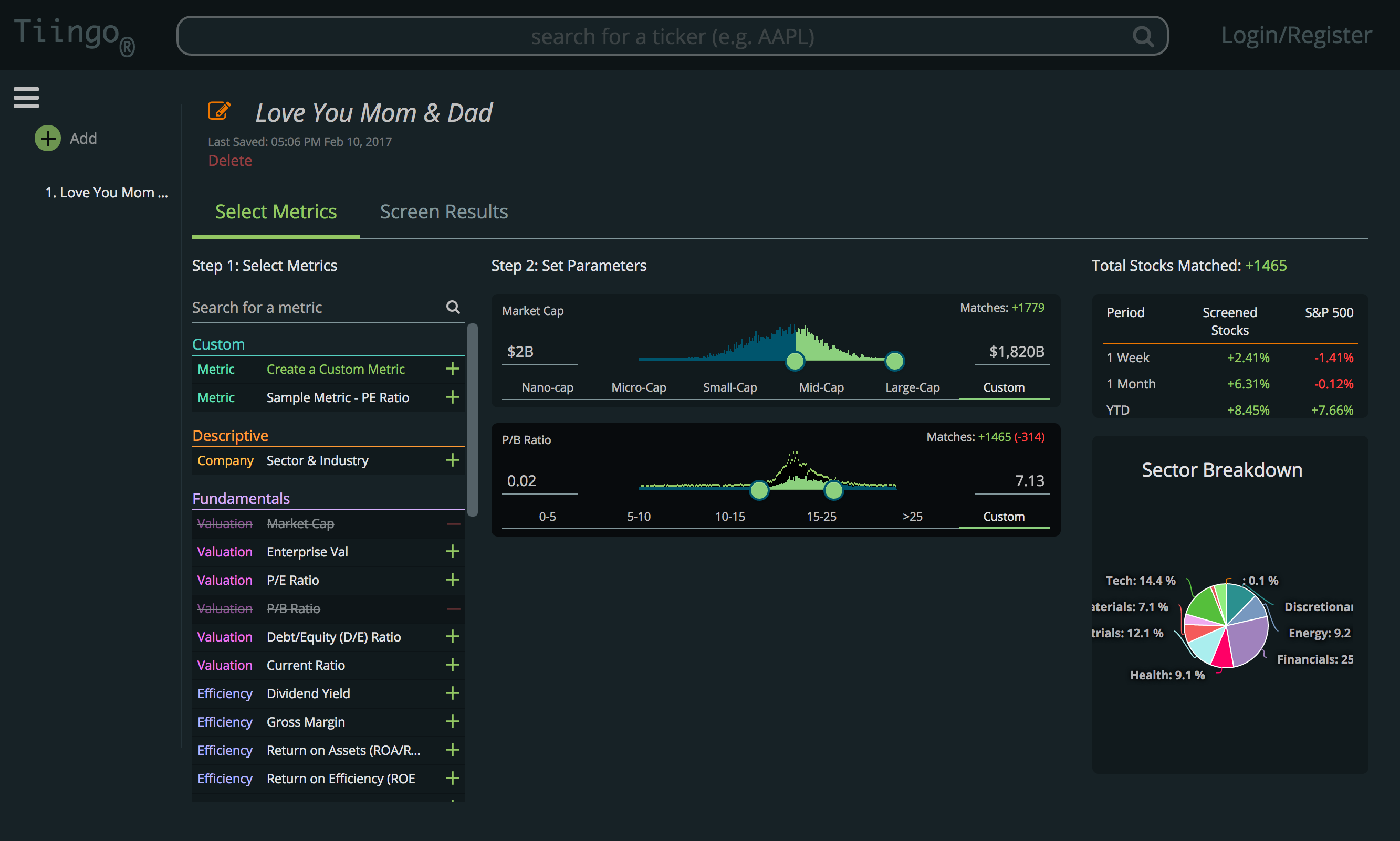
Its IEX offering provides access to top-of-book quotes and last-sale data, with both REST and WebSocket delivery. Tiingo states that its infrastructure receives raw binary feeds from IEX through a physical connection and processes the information before distributing it through its APIs.
The company’s WebSocket infrastructure sends updates when top-of-book prices change or when a trade occurs.
Why Tiingo is interesting
For developers, the infrastructure provides a more direct way to work with live market information without having to build the connectivity layer themselves.
Its IEX data includes:
- Bid and ask prices
- Last trade prices
- Trade sizes
- Timestamps
- Intraday pricing
- Historical market data
- WebSocket streaming
Tiingo also offers a derived real-time reference-price feed for customers that do not have the necessary IEX market-data agreement.
Best suited for: Developers, market-data applications, financial research tools, and products that need accessible real-time U.S. equity data.
7. Alpaca — Real-Time Data for Trading Applications
Alpaca is best known as a developer-focused brokerage and trading infrastructure company, but its market-data capabilities also make it relevant to the real-time financial data infrastructure ecosystem.
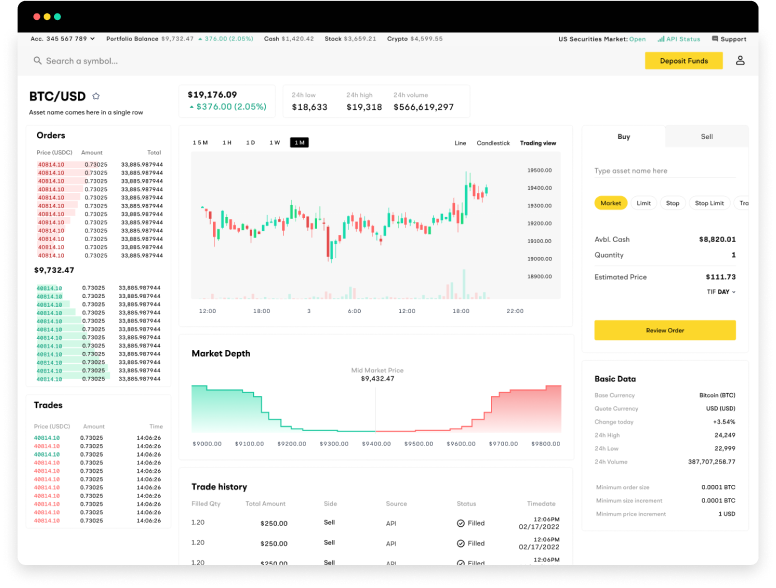
Alpaca provides WebSocket streams for stocks, crypto, options, and news, allowing applications to receive real-time market information instead of repeatedly polling APIs.
Its stock-data infrastructure includes different feeds such as SIP and IEX, as well as delayed and other specialized feeds depending on the user’s subscription.
The platform also provides WebSocket streams for account and order updates, extending the real-time architecture beyond market prices into trading activity.
Alpaca’s infrastructure layer
The platform can connect several components of a trading application:
Market data → Trading logic → Orders → Account updates
That combination makes it particularly relevant for automated trading applications where data and execution need to operate within the same developer-oriented ecosystem.
Best suited for: Algorithmic trading applications, brokerage products, trading bots, investment platforms, and developer-built financial products.
8. Plaid — Infrastructure for Bank Account and Transaction Data
While many companies on this list focus on market data, Plaid operates on another important layer of financial-data infrastructure: consumer-permissioned banking data.
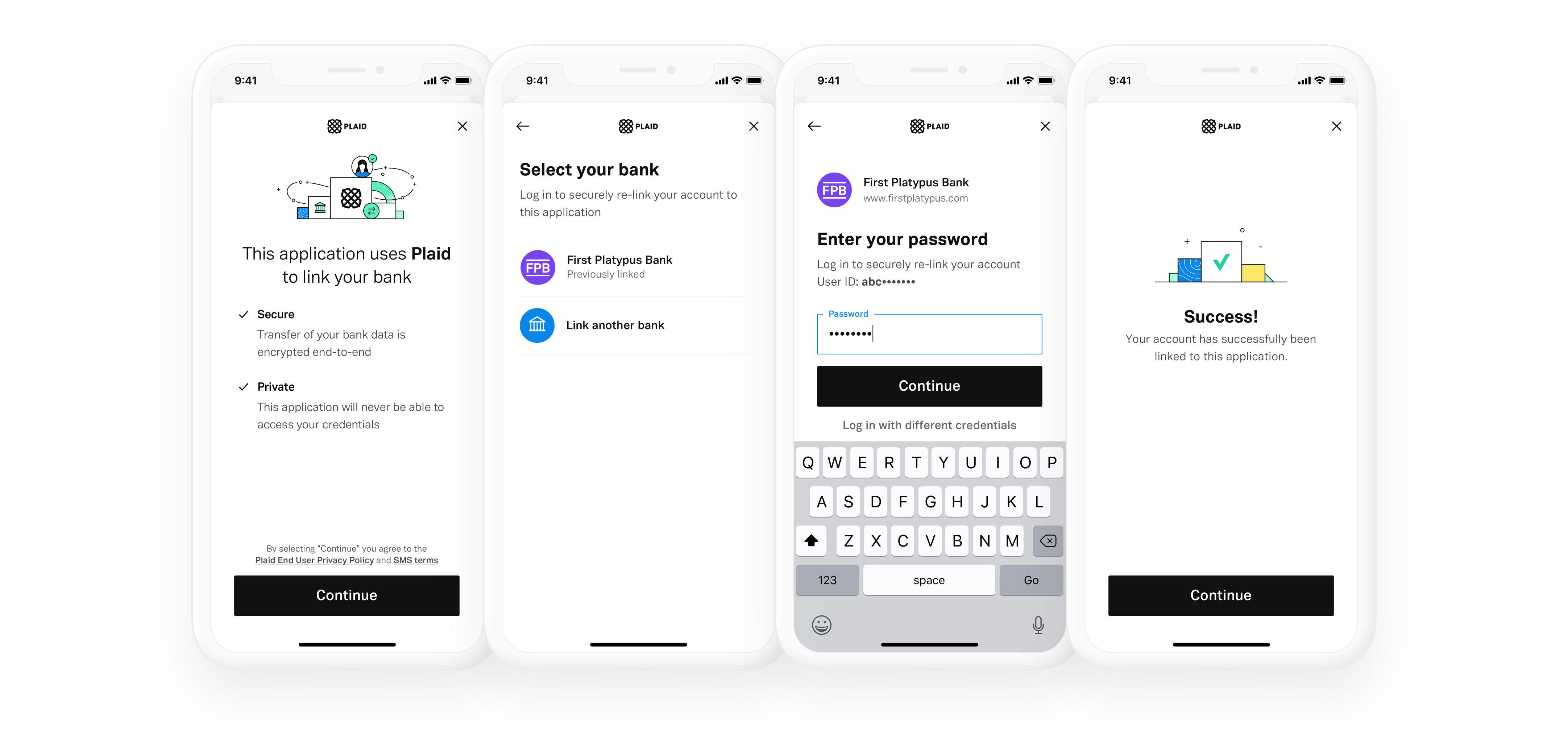
Plaid’s Transactions product allows applications to retrieve transaction history from connected financial accounts, including information such as transaction amount, merchant, category, and location. It also provides webhooks to notify applications when transaction information changes.
This infrastructure is widely relevant to applications that need to understand a user’s financial activity.
Potential use cases include:
- Personal finance applications
- Lending platforms
- Expense management
- Cash-flow analysis
- Wealth applications
- Banking applications
- Financial analytics
However, there is an important distinction around the term real-time.
Plaid’s standard transaction endpoints are not necessarily real-time because financial institutions may be queried periodically. Plaid says update frequency can vary from daily to every few hours depending on the institution and account type. It also provides a transaction refresh capability for applications that require fresher information. Plaid Support
That makes Plaid an important part of the real-time financial data infrastructure conversation, but developers should distinguish between event-driven updates, periodic synchronization, and genuinely real-time bank data.
Best suited for: Consumer fintech, lending, personal finance, banking, and financial applications that need connected-account data.
9. MX — Open Finance and Enriched Transaction Data
MX focuses on another major problem in financial data infrastructure: turning fragmented account information into structured, permissioned, and usable financial data.
Its Data Access platform provides an open-finance API designed around consumer-permissioned data sharing and FDX standards. MX also provides transaction-data enrichment, helping organizations transform raw financial transactions into more structured information.
MX’s infrastructure covers areas such as:
- Account information
- Transaction data
- Balance data
- Financial-data connectivity
- Transaction categorization
- Account verification
- Data enrichment
- Open-finance APIs
The company’s platform is particularly interesting because raw financial data is often not immediately useful to an application.
For example, a transaction may initially contain limited information. Data enrichment can add merchant context, classifications, categories, and other information that makes the transaction more useful for analytics and financial experiences.
MX also provides instant account verification and rapid balance-check capabilities for financial workflows.
Best suited for: Banks, fintech platforms, financial institutions, personal-finance applications, and businesses working with open-finance data.
10. TrueLayer — Open Banking Data Infrastructure
TrueLayer approaches financial-data infrastructure through open banking. As security becomes paramount in these integrations, firms often look for best cloud security companies to ensure their underlying protocols are robust.
Its Data API provides a unified interface for accessing account information, balances, transactions, and other financial data across integrated banking providers.
For developers, this means an application can work with different banks through a common API layer rather than building individual integrations for each financial institution.
TrueLayer’s infrastructure can expose:
- Account details
- Account balances
- Transactions
- Card information
- Recurring payments
- Running balances
- Banking-provider connectivity
Its transaction APIs can also work with asynchronous requests and webhooks, which can help applications manage data retrieval without relying entirely on synchronous API calls.
The result is a financial-data layer designed for applications operating within open-banking ecosystems.
Best suited for: European fintechs, open-banking applications, payments platforms, personal finance tools, and financial services requiring bank-account connectivity.
Real-Time Financial Data Infrastructure: Market Data vs. Banking Data
One important takeaway from these companies is that financial data infrastructure is not a single category.
The market can broadly be divided into two layers:
| Infrastructure Layer | Typical Data | Example Companies |
|---|---|---|
| Market Data Infrastructure | Prices, trades, quotes, options, FX, crypto | Massive, Databento, Twelve Data, QUODD |
| Financial Data APIs | Fundamentals, financial statements, reference data | Intrinio, Tiingo |
| Trading Data Infrastructure | Market data + account/order events | Alpaca |
| Open Finance Infrastructure | Bank accounts, balances, transactions | Plaid, MX, TrueLayer |
This distinction matters because a company building an algorithmic trading platform has very different data requirements from a company building a personal-finance application.
A trading system may need millisecond-sensitive market events, while a budgeting application may care more about transaction categorization and reliable account synchronization.
Why Real-Time Financial Data Infrastructure Matters
Financial applications increasingly depend on data that is both fresh and structured.
Consider a modern investment application. It may need to process:
- A live market quote
- Historical price information
- Company fundamentals
- Corporate actions
- User portfolio positions
- Account balances
- Transaction history
- News or market events
Building every one of these connections internally would require significant engineering, data licensing, infrastructure, and compliance work.
Specialized financial-data infrastructure providers abstract much of this complexity behind APIs, WebSockets, SDKs, feeds, and standardized data models.
This allows developers to spend more time building the actual financial product rather than maintaining the underlying data pipeline.
The Future of Financial Data Infrastructure
The next generation of financial applications is likely to require more than simply retrieving data from an API.
AI agents, automated trading systems, financial copilots, and real-time analytics applications need financial information that is:
- Structured
- Machine-readable
- Continuously updated
- Contextualized
- Historically consistent
- Easy to query
- Available through APIs
This creates an opportunity for infrastructure companies to move beyond basic data delivery toward financial-data intelligence layers. For those interested in the broader shift toward decentralized systems, exploring securing healthcare data provides context on how data ownership might evolve.
Instead of simply returning a stock price or bank transaction, future platforms may increasingly combine live events with historical context, entity resolution, financial relationships, and analytics.
The companies building this infrastructure sit underneath the visible financial products consumers and businesses interact with every day.
Frequently Asked Questions
1. What is real-time financial data infrastructure?
Real-time financial data infrastructure is the technology used to collect, process, standardize, and deliver financial information to applications with minimal delay. It can include market prices, trades, quotes, bank transactions, balances, and other financial information.
2. What is the difference between a financial data API and a WebSocket?
A REST API generally requires an application to request data. A WebSocket creates a persistent connection through which the provider can push new information as it becomes available. WebSockets are therefore particularly useful for continuously changing market data.
3. Which companies provide real-time market data APIs?
Companies such as Massive, Databento, Twelve Data, QUODD, Intrinio, Tiingo, and Alpaca provide various forms of real-time or streaming market-data infrastructure.
4. Which companies provide real-time banking data?
Plaid, MX, and TrueLayer provide infrastructure for accessing bank-account, balance, and transaction information. However, “real-time” can mean different things depending on the underlying financial institution and connectivity method. Plaid, for example, notes that standard transaction updates can be periodic rather than continuously real-time.
5. Why do fintech companies use financial data APIs?
Financial data APIs allow fintech companies to access complex financial information without building direct integrations with every exchange, bank, or financial institution. This can significantly reduce development and maintenance requirements.


