



When launching a digital asset platform, choosing the right infrastructure is critical. Matching engine, liquidity, licences: Top 10 white-label exchange vendors side by side provides a clear look at how providers handle these core requirements. Behind every trading interface are essential layers—including wallets, risk controls, KYC/AML, and market data—that determine whether a platform can operate reliably.
Businesses considering a white-label crypto exchange increasingly look beyond branding and time-to-market. The more important questions are how orders are matched, where liquidity comes from, how the platform connects to external venues, what compliance tooling is included, and which licensing responsibilities remain with the exchange operator. Understanding the different types of crypto exchanges is a vital first step for any entrepreneur.
This comparison looks at 10 established white-label crypto exchange vendors with different approaches to exchange infrastructure. The list focuses on companies active in the exchange-technology market rather than global consumer brands or extremely large financial corporations.
Important: Vendor capabilities, licensing arrangements, liquidity sources, and commercial terms can vary by deployment and jurisdiction. The comparison below describes publicly documented offerings and should not be treated as legal or technical due diligence.
Matching engine, liquidity, licences: Top 10 white-label exchange vendors side by side
1. B2Broker
Best known for: Integrated exchange, brokerage, liquidity and operational infrastructure
B2Broker approaches the white-label exchange market as part of a broader trading ecosystem rather than as an isolated exchange application. Its turnkey solution combines a matching engine, wallets, liquidity, KYC, payment services, CRM and back-office components.
The trading infrastructure supports multiple asset classes, including crypto spot and derivatives. B2Broker also describes its liquidity infrastructure as connecting to multiple liquidity venues and allowing clients to add their own liquidity providers through supported connectivity.
Matching engine
The exchange stack includes order matching, position keeping, risk and margin enforcement. This makes it particularly relevant for operators planning to support more than basic spot trading.
Liquidity
Liquidity is one of the major parts of the B2Broker ecosystem. Its infrastructure supports aggregated liquidity across crypto and other asset classes, while B2CONNECT provides connectivity to external exchanges and liquidity venues.
Licensing
B2Broker states that it works with licensing partners across major jurisdictions and can provide guidance around licensing requirements. However, the exchange operator still needs to establish the appropriate legal and regulatory structure for its own business.
Why consider it: Businesses looking for a relatively integrated stack covering trading, liquidity, CRM, wallets and operational infrastructure.
2. ChainUp
Best known for: Broad exchange infrastructure, liquidity and compliance services
ChainUp is one of the more comprehensive providers in this category, offering centralized exchange software alongside custody, liquidity, compliance and other digital-asset infrastructure. If you are researching the market, you can learn more about what defines a centralized exchange before selecting your vendor.
Its CEX product is available through SaaS and private deployment models, while the company also provides compliance and regulatory services around the exchange infrastructure. ChainUp states that its exchange solution supports more than 3,000 trading pairs through its liquidity services.
Matching engine
ChainUp positions its exchange infrastructure around high-performance centralized exchange technology. The company states that its matching engine is designed for large-scale trading activity, with its current materials citing more than 50,000 transactions per second.
Liquidity
Liquidity is one of ChainUp’s major selling points. Its platform incorporates a liquidity network designed to provide access to a broad range of trading pairs rather than requiring every new exchange to build its own liquidity relationships from scratch.
Licensing
ChainUp has a dedicated compliance and licensing service covering areas such as jurisdiction selection, legal-entity setup, KYC/AML, regulatory applications and ongoing compliance. Its terms also make clear that customers remain responsible for obtaining and maintaining the licences required for their activities.
Why consider it: Businesses that want exchange software combined with liquidity, compliance and broader digital-asset infrastructure.
3. AlphaPoint
Best known for: Institutional exchange infrastructure and regulated-market environments

AlphaPoint has focused on digital-asset exchange infrastructure for institutions for more than a decade. Its current exchange platform is positioned around high availability, multi-region infrastructure, risk controls and high-performance execution.
Matching engine
AlphaPoint highlights high-performance matching and deterministic execution under load. Its architecture also separates front-end and back-office functions, which can be useful for institutional operating models.
Liquidity
The platform supports liquidity connectivity through AlphaPoint Global as well as integration with third-party custody and other external infrastructure.
Licensing
Rather than presenting licensing as a universal licence attached to its software, AlphaPoint positions the platform for institutions operating in regulated environments. Its product architecture includes risk controls, auditability and reporting capabilities designed for those environments.
AlphaPoint says its infrastructure has supported more than 200 customers across 35+ countries, although these figures are company-reported.
Why consider it: Banks, financial institutions, brokerages and operators that place greater emphasis on institutional infrastructure and operational controls.
4. HollaEx
Best known for: Open-source flexibility and self-hosted exchange deployment

HollaEx takes a somewhat different approach from heavily managed enterprise platforms. Its ecosystem is built around an exchange kit that can be deployed through hosted or self-managed configurations.
The platform is particularly relevant to businesses that want greater technical control over their exchange environment rather than relying exclusively on a closed SaaS architecture.
Matching engine
HollaEx provides an automated trade-matching engine as part of its exchange infrastructure.
Liquidity
Liquidity configuration depends on the exchange’s deployment and market setup. This is an important distinction: buying exchange software does not automatically mean that every market will have sufficient independent liquidity.
Licensing
HollaEx provides the technical exchange infrastructure and compliance-related integrations, but licensing requirements ultimately depend on the operator’s jurisdiction, business model and services.
This distinction matters particularly in 2026. Under MiCA, for example, firms providing regulated crypto-asset services in the EU generally require appropriate authorisation, with the relevant requirements applying to the actual service provider rather than simply the technology vendor.
Why consider it: Technical teams that value deployment flexibility, customization and greater control over the underlying exchange environment.
5. Shift Markets
Best known for: Modular exchange infrastructure, liquidity and market-making
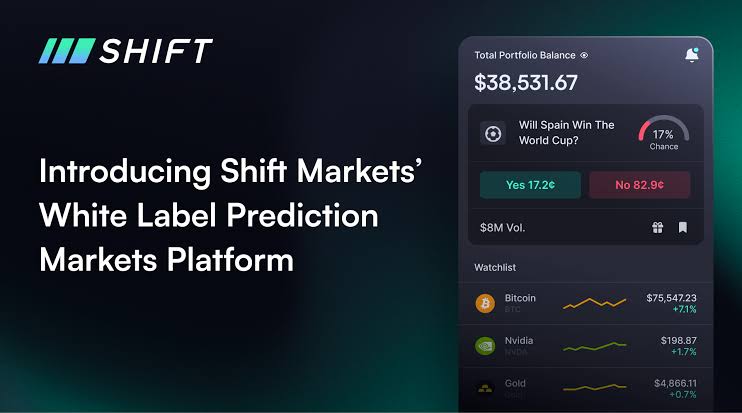
Shift Markets provides a modular white-label platform covering exchange trading, derivatives, back-office functions, digital-asset ledgers, payments and liquidity.
The company reports that its platform has been used to launch more than 200 exchanges and 75 brokerages, with the figures being company-reported.
Matching engine
The Shift Platform provides trading infrastructure for spot and derivatives markets, with APIs designed to connect front-end components to the underlying trading stack.
Liquidity
Liquidity is a central component of the platform. Shift describes aggregated liquidity, market-making tools and controls that allow operators to configure liquidity providers and trading conditions.
Licensing
Shift Markets also offers regulatory consulting and licensing advisory services. However, its own materials explicitly distinguish advisory support from the operator’s responsibility to comply with applicable laws.
Why consider it: Businesses looking for modular exchange infrastructure where liquidity, market making and trading functionality are closely connected.
6. Openware / OpenDAX
Best known for: Customizable and self-controlled exchange infrastructure
Openware’s OpenDAX Aurora is designed around a modular architecture, giving businesses more control over the underlying technology stack than a conventional hosted white-label product.
The platform includes the OpenFinex matching engine, liquidity integrations, KYC/AML integrations, custody connections and fiat on/off-ramp integrations.
Matching engine
Openware describes OpenFinex as a high-performance trading engine capable of handling millions of trades per second. These are vendor-published specifications rather than independent benchmark results.
Liquidity
OpenDAX provides integrations with external liquidity providers and also supports external exchange routing. Its documentation describes connectivity to external venues through upstream drivers.
Licensing
One notable characteristic is the deployment model. Openware offers a perpetual software licence option with deployment on the customer’s cloud or bare-metal infrastructure and access to source code under the applicable agreement.
Why consider it: Operators that want greater ownership and control over deployment, customization and the underlying exchange technology.
7. Devexperts
Best known for: Capital-markets-grade trading infrastructure

Devexperts is not exclusively a crypto company. Its technology background spans multiple financial markets, which makes its crypto exchange offering somewhat different from crypto-native white-label providers.
Its exchange infrastructure includes DXmatch, an exchange engine covering matching, market data, risk management, reporting, APIs and administrative functions.
Matching engine
DXmatch is designed as a high-performance exchange matching engine. Devexperts currently states that one segment can process up to 100,000 orders per second, with additional scaling through multiple segments.
Liquidity
Its crypto trading platform connects to third-party cryptocurrency liquidity providers, allowing the technology to sit between the operator’s trading interface and external market liquidity.
Licensing
Devexperts primarily provides trading technology rather than functioning as the exchange operator’s universal regulatory licence. Its value is more closely tied to trading infrastructure, execution, market data, risk management and enterprise integration.
Why consider it: Financial businesses that want exchange technology with a strong traditional capital-markets infrastructure background.
8. PayBito Pro
Best known for: Packaged white-label exchange infrastructure

PayBito Pro offers a more turnkey-oriented exchange model, combining the branded front end with matching, wallets, liquidity and administrative functionality.
Its current product materials list order books, matching-engine infrastructure, liquidity tools, KYC and customer management as components of its white-label exchange offering.
Matching engine
The platform includes a matching engine with multi-currency order books and trading functionality.
Liquidity
PayBito describes liquidity integration and routing as part of its exchange infrastructure. Its current platform materials also describe configuration of trading pairs, order-book precision and liquidity settings.
Licensing
PayBito Pro markets its platform alongside what it describes as global crypto licences and compliance functionality. These claims should be checked against the specific legal entity, jurisdiction and service being offered before launch rather than treated as a blanket licence for every operator.
Why consider it: Companies looking for a packaged exchange solution with a relatively broad set of pre-integrated functions.
9. Antier
Best known for: Highly customized exchange development and multi-market functionality
Antier approaches white-label exchange infrastructure with a strong development and customization component. Its current platform combines trading, liquidity, wallet, risk-management, KYC/AML and administrative modules.
Matching engine
Antier’s platform includes an advanced matching engine, with support for spot trading and more advanced trading products depending on the implementation.
Liquidity
The platform includes an external liquidity module and market-maker integrations. Antier also describes liquidity connectivity through APIs and market-making infrastructure.
Licensing
Antier increasingly positions its infrastructure around jurisdiction-specific regulatory requirements. Its 2026 materials describe MiCA-aligned and VARA-oriented exchange architectures, including KYC/AML, custody, reporting and other compliance components. These should be understood as technology/compliance-readiness claims rather than a substitute for the operator obtaining the legally required authorisation.
Why consider it: Businesses that need a white-label foundation but expect significant customization around products, markets or compliance architecture.
10. HashCash Consultants
Best known for: Configurable exchange architecture and custom development

HashCash Consultants provides white-label centralized exchange infrastructure covering the main components required for a CEX, including order books, matching engines, wallets, KYC, liquidity connectivity, APIs and administration.
Matching engine
HashCash documents a configurable price-time-priority matching engine. Its published technical specifications describe very low latency and high order throughput, although actual production performance depends on deployment and operating conditions.
Liquidity
Liquidity is treated as a separate infrastructure layer connected to the matching engine. HashCash describes integration with selected liquidity sources and external venues depending on the exchange’s trading requirements.
Licensing
Its exchange architecture includes KYC/verification, geography-specific compliance workflows and reporting. HashCash also emphasizes that licensing and operating responsibilities depend on the business model and jurisdiction.
Why consider it: Businesses that want a configurable exchange architecture and may require additional development around their specific operating model.
What Actually Matters When Comparing White-Label Exchange Vendors?
A feature checklist alone is not enough. Two vendors can both advertise a “high-performance matching engine” while providing very different infrastructure and operating models.
1. Matching Engine Architecture
The matching engine is the execution core of a centralized exchange.
When comparing vendors, look beyond phrases such as “high performance” and ask:
- What matching model is used?
- What order types are supported?
- How is latency measured?
- Is the engine horizontally scalable?
- Can market parameters be customized?
- Does it support spot, margin and derivatives?
- Is there a FIX/API layer?
- How does it behave during market volatility?
A published TPS number should also be treated carefully. A vendor’s theoretical throughput is not necessarily the same as end-to-end production performance.
2. Liquidity Is Not the Same as a Matching Engine
This is one of the most important distinctions when selecting a white-label exchange.
A matching engine determines how orders interact inside the exchange.
Liquidity, meanwhile, determines how much trading activity and available market depth exists.
A platform can have an excellent matching engine and still launch with thin order books.
Liquidity can come from:
- External exchanges
- Liquidity aggregators
- Professional market makers
- Internal market-making systems
- Other institutional liquidity providers
- Hybrid routing models
For this reason, buyers should ask vendors exactly where liquidity comes from, which venues are connected, who controls the liquidity relationship, and what happens if a liquidity provider becomes unavailable.
3. Licensing Is a Separate Layer From Software
A white-label exchange platform does not automatically give the operator the legal right to provide crypto services. If you are new to this space, you should review our What is Crypto Exchange? The ultimate guide for beginners [update 2026] to understand the regulatory landscape.
This distinction is particularly important in 2026.
Under MiCA, crypto-asset service providers operating within the EU generally need the appropriate authorisation, and ESMA maintains a register of authorised crypto-asset service providers.
ESMA also stated in June 2026 that the MiCA transitional period ended on 1 July 2026, meaning unauthorised providers subject to the regime must wind down relevant EU activities unless authorised or otherwise covered by the applicable framework.
Therefore, when a vendor says it offers a “licensed,” “compliant,” “MiCA-ready” or “regulated” solution, buyers should clarify:
- Who actually holds the licence?
- Which legal entity holds it?
- Which jurisdiction does it cover?
- Which services does the authorisation cover?
- Does the licence belong to the vendor, a partner, or the operator?
- Can the operator use the arrangement under its own brand?
- Who remains legally responsible for AML/KYC and reporting?
This distinction can prevent one of the most expensive misunderstandings in a white-label exchange project.
Frequently Asked Questions
1. What is a white-label crypto exchange?
A white-label crypto exchange is pre-built exchange infrastructure that can be customized and operated under another company’s brand. Depending on the provider, the package may include a matching engine, wallets, liquidity connectivity, KYC/AML, trading interfaces, APIs and administrative tools.
The exact scope varies significantly between vendors, so “white-label” should not be treated as a standardized product category.
2. Which white-label crypto exchange vendors provide liquidity?
Many vendors provide or facilitate liquidity connectivity, but their models differ.
B2Broker offers aggregated liquidity and external venue connectivity; ChainUp promotes its own liquidity network; Shift Markets combines liquidity and market-making infrastructure; Openware provides integrations with external liquidity providers; and AlphaPoint provides liquidity connectivity through AlphaPoint Global.
The important question is not simply whether a vendor “has liquidity,” but how that liquidity reaches the exchange’s order book.
3. Does buying white-label exchange software provide a crypto licence?
Not necessarily.
Software licensing and regulatory authorisation are separate matters. Depending on the jurisdiction and services offered, the exchange operator may need its own registration or licence. In the EU, MiCA requires relevant crypto-asset service providers to obtain the appropriate authorisation unless they fall within a permitted alternative category.
A vendor may provide licensing assistance, compliance technology or work with regulatory partners, but those services should not automatically be interpreted as a regulatory authorisation for the customer.
4. What is the difference between a matching engine and liquidity?
The matching engine processes buy and sell orders according to the exchange’s matching rules.
Liquidity represents the available trading depth that allows those orders to be executed.
For example, an exchange could have a technically fast matching engine but still experience wide spreads or significant slippage if its markets do not have sufficient liquidity. For those interested in non-custodial options, exploring decentralized exchanges dex can provide a different perspective on liquidity and order execution.
5. How much does white-label crypto exchange software cost?
There is no universal price because vendors package the technology differently.
Costs can depend on:
- Number of trading pairs
- Spot vs. derivatives functionality
- Liquidity requirements
- Hosting model
- Source-code access
- Mobile applications
- Wallet infrastructure
- KYC/AML integrations
- Regulatory support
- Custom development
- Ongoing maintenance
- Transaction or revenue-sharing arrangements
For a serious exchange project, the technology licence should therefore be evaluated together with liquidity, custody, compliance, infrastructure and regulatory costs, rather than as a standalone software purchase. If you are building a platform, you may also need to research Top 10 crypto KYC and KYB providers for exchanges, wallets and launchpads in 2026 to ensure your compliance stack is robust.


