



The Top 10 Chainalysis alternatives for AML teams in 2026 offer diverse solutions for cryptocurrency compliance, moving beyond Chainalysis’s established tools for transaction monitoring, investigations, and financial-crime intelligence. While Chainalysis remains a prominent name in blockchain analytics, its comprehensive suite is not always a perfect fit for every compliance team’s specific needs.
A regional crypto exchange may prioritize straightforward Know Your Transaction (KYT) monitoring and API integration. A European CASP may put greater emphasis on MiCA-aligned compliance workflows. A bank entering digital assets may need transaction monitoring that connects blockchain activity with existing financial-crime systems. Meanwhile, an investigation team may care more about cross-chain tracing, entity attribution, and forensic evidence.
That is why the market for Chainalysis alternatives has become increasingly diverse.
Beyond the biggest names in blockchain intelligence, a growing group of specialized providers now focuses on specific parts of the crypto AML stack. These include transaction monitoring, wallet screening, behavioral analytics, blockchain investigations, compliance automation, and intelligence enrichment.
This guide looks at seven companies that are worth considering when evaluating blockchain analytics tools and crypto AML software outside the largest established providers.
The list deliberately focuses on specialized and mid-market players rather than extremely large technology companies. The goal is not to identify one universal replacement for Chainalysis, but to show how different platforms approach crypto compliance and which operating environments they may fit.
What Should You Look for in a Chainalysis Alternative?
Before comparing providers, AML and compliance teams should define what they actually need from a blockchain analytics platform.
A useful evaluation framework includes:
- Blockchain coverage: Which networks and assets can the platform monitor?
- Wallet screening: Can teams assess addresses before accepting deposits or transfers?
- Transaction monitoring: Does the platform continuously monitor activity and generate alerts?
- Risk scoring: How are wallet and transaction risks categorized?
- Entity attribution: Can addresses be connected to exchanges, services, sanctioned entities, or other known organizations?
- Cross-chain investigation: Can investigators follow funds across multiple networks?
- Behavioral analytics: Does the platform detect suspicious behavior rather than relying only on static exposure?
Top 10 chainalysis alternatives for AML teams in 2026
1. Scorechain
Best suited for: European CASPs, exchanges, wallets, fintechs, and compliance teams looking for configurable AML workflows
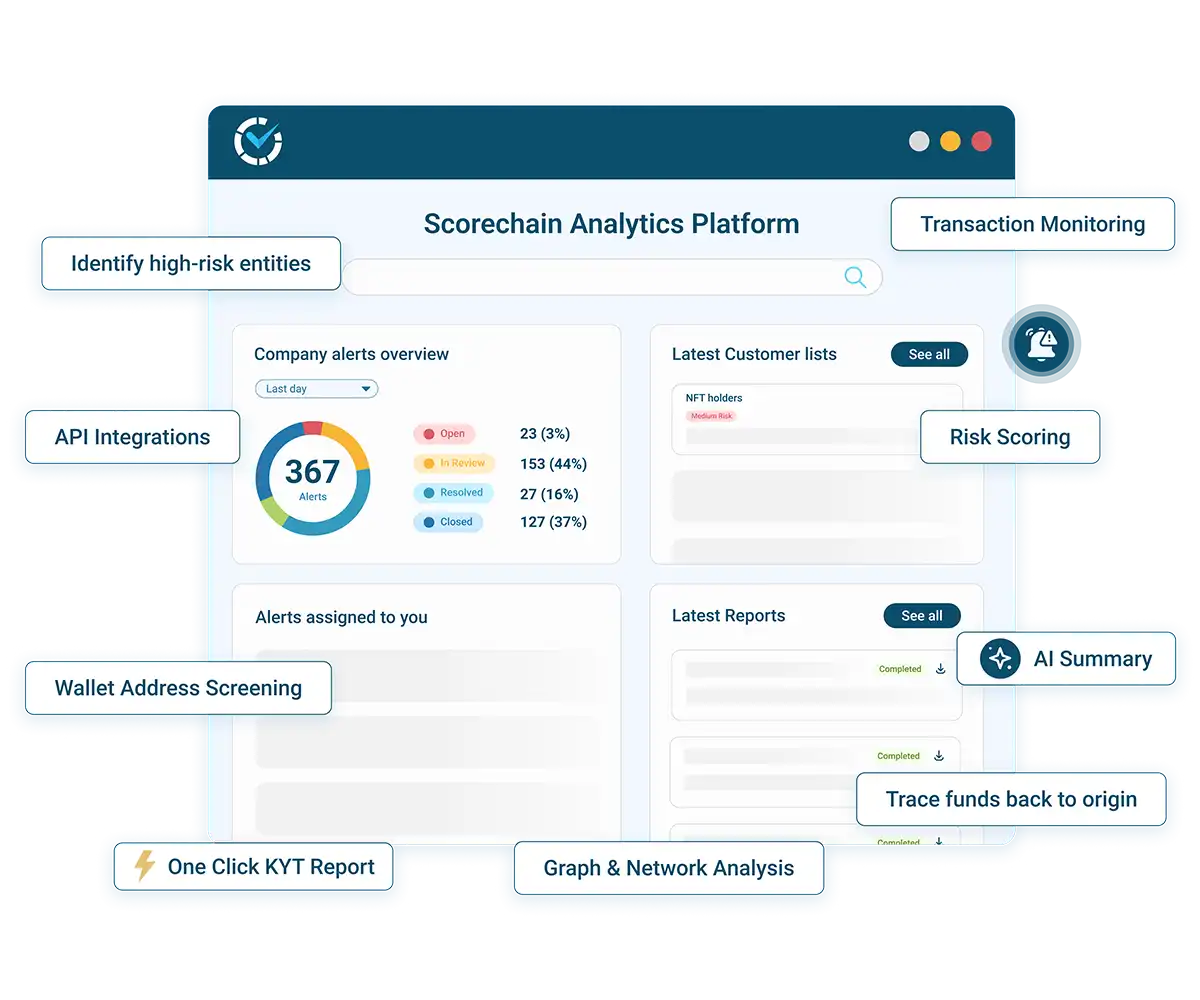
Scorechain is a European blockchain analytics and AML compliance company with a strong focus on operational compliance for digital-asset businesses.
Its platform combines blockchain exploration, wallet screening, transaction monitoring, risk scoring, investigations, and KYA/KYT reporting. Scorechain currently describes its solution as API-first and supports blockchain analysis across more than 21 networks. It also emphasizes EU-hosted infrastructure and experience with MiCA-related compliance requirements.
Key features
- Wallet screening
- Know Your Transaction (KYT)
- Blockchain investigations
- Risk scoring
- Transaction monitoring
- KYA and KYT reports
- Counterparty identification
- Custom risk indicators
- Configurable alerts
- API and integration tools
One of Scorechain’s main differentiators is its emphasis on customization.
Compliance teams can configure scenarios, risk indicators, scoring, and alerts according to their own policies rather than relying entirely on a fixed risk model.
This can be particularly relevant for organizations operating under different regulatory environments or with different risk appetites.
Why consider Scorechain?
Scorechain is particularly interesting for businesses that want blockchain analytics to become part of their daily compliance operation, rather than using it only as an investigation tool.
Its European positioning also makes it relevant for CASPs evaluating blockchain analytics as part of a broader EU compliance framework.
Potential fit: European CASPs, exchanges, custodians, wallets, fintechs, and mid-sized financial institutions.
2. Merkle Science
Best suited for: Compliance and investigation teams interested in predictive and behavioral risk analytics
.webp)
Merkle Science approaches blockchain analytics with a strong emphasis on predictive risk intelligence and behavioral analysis.
Its platform includes Compass, focused on compliance, AML, KYC, CFT, and predictive risk monitoring, and Tracker, which supports forensic investigations into illicit cryptocurrency activity. Merkle Science says its investigation technology covers more than 10,000 assets and 200 bridges.
Key features
- Predictive crypto risk monitoring
- Transaction monitoring
- Behavioral analytics
- Wallet risk assessment
- Cross-chain investigations
- Forensic investigations
- Sanctions-risk detection
- Blockchain intelligence
- Data analytics
The behavioral element is important because suspicious activity does not always appear as a single obviously problematic transaction.
A wallet may interact with multiple addresses and services before a broader pattern becomes visible. Behavioral analytics can help compliance teams analyze these patterns instead of evaluating each transaction independently.
Merkle Science also positions its platform for organizations operating across Web3, financial services, and digital-asset infrastructure.
Why consider Merkle Science?
Merkle Science can be relevant for teams that want to move beyond basic address screening toward predictive and behavior-based risk analysis.
It is also worth considering when investigations involve multiple chains, bridges, assets, and transaction patterns.
Potential fit: Exchanges, financial institutions, Web3 companies, compliance teams, and investigation units.
3. Crystal Intelligence
Best suited for: Financial institutions, regulated crypto companies, exchanges, and teams combining transaction monitoring with investigations
Crystal Intelligence provides blockchain analytics, crypto compliance, transaction monitoring, sanctions screening, and investigation capabilities through a unified platform.
Its current product positioning includes real-time KYT, wallet and counterparty risk assessment, transaction monitoring, blockchain investigations, and entity attribution. Crystal states that its platform covers more than 330 blockchains and provides verified attribution for more than 118,000 entities.
Key features
- Real-time KYT
- Wallet screening
- Transaction monitoring
- Sanctions screening
- Entity attribution
- Cross-chain investigations
- Counterparty risk
- Case investigation
- Compliance reporting
- API integration
One of Crystal’s notable characteristics is its emphasis on evidence behind risk decisions.
Instead of presenting a risk score without context, the platform connects compliance decisions with blockchain evidence, attribution, and investigation data.
This can matter for regulated organizations that need to explain why a transaction or customer relationship was flagged.
Crystal also targets banks and payment providers entering digital assets, making it relevant beyond crypto-native exchanges.
Why consider Crystal Intelligence?
Crystal is worth evaluating when a company needs both transaction monitoring and deeper blockchain investigations in the same environment.
It may be particularly relevant for organizations where compliance decisions need to be documented and supported by evidence.
Potential fit: Banks, payment providers, exchanges, CASPs, custodians, and compliance teams.
4. AMLBot
Best suited for: Small and mid-sized crypto businesses looking for accessible AML and KYT infrastructure
AMLBot takes a more accessible approach to crypto compliance.
The platform provides wallet screening, real-time transaction monitoring, KYC/KYB verification, blockchain investigations, and asset-recovery-related services. AMLBot also offers API-based access and supports screening across major blockchain networks and hundreds of digital assets.
Key features
- AML wallet screening
- Risk scoring
- KYT
- Real-time transaction monitoring
- KYC/KYB
- Blockchain investigations
- API access
- Compliance reporting
- Asset recovery support
The company explicitly positions itself for smaller businesses and individual users as well as larger compliance operations.
This makes AMLBot relevant for organizations that may not need the complexity of a large enterprise blockchain intelligence deployment.
For example, a smaller exchange may primarily need to screen deposits and withdrawals, identify risky wallet exposure, and integrate automated AML checks into its platform.
Why consider AMLBot?
AMLBot can be useful when the primary goal is to establish practical AML controls without building an extremely complex enterprise compliance stack.
Its combination of wallet screening, KYT, KYC/KYB, and investigation functionality also gives smaller teams the option to consolidate several compliance tasks.
Potential fit: Small and mid-sized exchanges, wallets, OTC desks, payment providers, and Web3 businesses.
5. AnChain.AI
Best suited for: Organizations looking for AI-assisted blockchain investigations and automated AML workflows
AnChain.AI combines blockchain intelligence with machine learning and AI-assisted investigation workflows.
Its AML platform currently advertises support for more than 41 blockchains, multi-chain risk scoring, entity clustering, behavioral modeling, and cross-chain graph intelligence. Its Auto-Trace system is designed to automate the tracing of cryptocurrency fund flows, while Auto-Report can turn investigation findings into structured reports.
Key features
- Crypto AML/KYT
- Real-time risk scoring
- Entity clustering
- Behavioral modeling
- Cross-chain analysis
- Automated fund tracing
- Investigation automation
- Automated reporting
- AI-assisted analytics
- VASP intelligence
Automation is the main differentiator.
Blockchain investigations can become extremely time-consuming when analysts have to manually follow transactions through multiple wallets, bridges, exchanges, or protocols.
AnChain.AI’s Auto-Trace approach is designed to automate parts of this process while retaining an investigation trail for compliance and reporting purposes.
Why consider AnChain.AI?
AnChain.AI is worth considering when investigation teams are dealing with large transaction volumes or complex cross-chain flows and want to reduce repetitive manual analysis.
Potential fit: Exchanges, financial institutions, regulators, investigation teams, and high-volume digital-asset businesses.
6. NOMINIS
Best suited for: Teams that need on-chain intelligence combined with off-chain and behavioral signals

NOMINIS takes a broader intelligence approach to crypto compliance.
Its platform combines on-chain blockchain analytics with off-chain intelligence and behavioral signals. Its wallet-screening product currently describes coverage across 70+ blockchains, more than 50 transaction hops, and clusters involving more than 1 billion addresses.
Key features
- Wallet screening
- KYT
- Transaction monitoring
- Cross-chain tracing
- Behavioral analytics
- Wallet attribution
- Off-chain intelligence
- Dark-web intelligence
- Risk scoring
- Continuous monitoring
The distinction is that NOMINIS does not focus exclusively on what happens directly on-chain.
Its intelligence layer can also incorporate off-chain and behavioral signals, giving analysts additional context around potentially risky wallets and transactions.
This can be useful when a wallet’s transaction history alone does not tell the complete story.
Why consider NOMINIS?
NOMINIS may be particularly relevant for teams conducting deeper investigations where context and attribution matter as much as transaction history.
Its API-based model can also make it suitable for embedding risk intelligence directly into an existing AML stack.
Potential fit: VASPs, exchanges, DeFi businesses, financial institutions, investigators, and crypto compliance teams.
7. Solidus Labs
Best suited for: Exchanges and financial institutions that need AML monitoring alongside broader market surveillance

Solidus Labs is somewhat different from several providers on this list because its focus extends beyond blockchain analytics alone.
Its HALO platform combines transaction monitoring, trade surveillance, KYC intelligence, case management, and risk-based detection. Its transaction-monitoring product is designed to monitor digital assets, tokens, stablecoins, and fiat flows.
Key features
- Crypto transaction monitoring
- AML monitoring
- KYC intelligence
- Trade surveillance
- Case management
- Behavioral analytics
- Risk detection
- Crypto and fiat monitoring
- Compliance workflows
This broader approach can matter for digital-asset exchanges.
An exchange may need to identify suspicious deposits and withdrawals while also monitoring trading behavior, market manipulation, account activity, and other risks.
Solidus Labs therefore fits more naturally into a broader market-integrity and compliance architecture than a pure blockchain-forensics workflow.
Why consider Solidus Labs?
Solidus Labs is worth evaluating when AML transaction monitoring needs to coexist with market surveillance and other forms of digital-asset risk management.
It may also work as part of a broader stack rather than serving as a one-for-one replacement for every blockchain intelligence capability.
Potential fit: Crypto exchanges, trading platforms, financial institutions, custodians, and regulated digital-asset businesses.
8. Global Ledger
Best suited for: Exchanges, financial institutions, OTC desks, and teams prioritizing fast transaction risk analysis
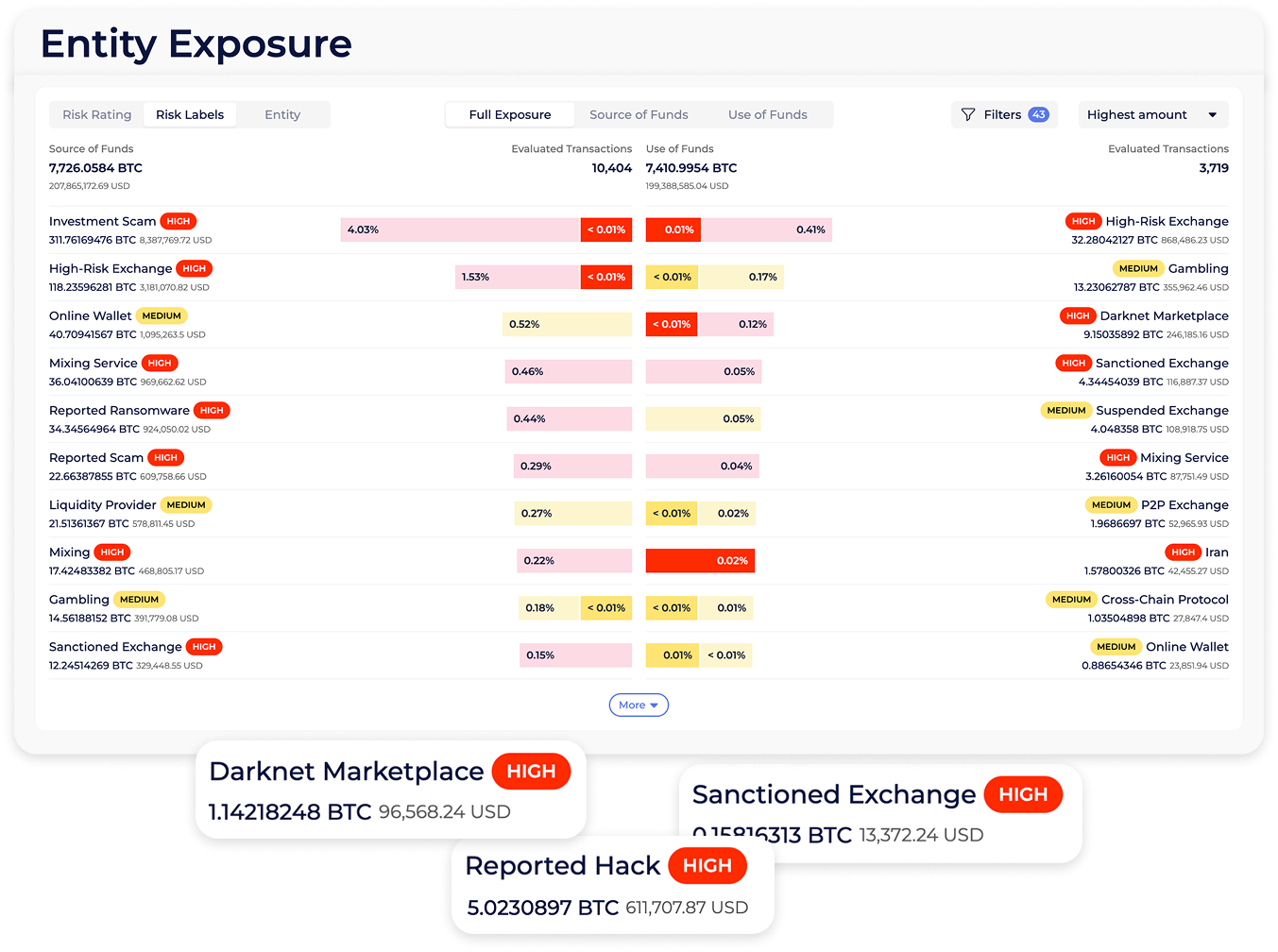
Global Ledger is a Swiss blockchain analytics company focused on AML compliance, transaction monitoring, investigations, and risk scoring.
The company says its platform covers more than 700 million attributed addresses and supports more than 2,000 digital assets, with automated AML checks and real-time risk monitoring. It also promotes an average response time of around 500 milliseconds for its risk-analysis workflows.
Key features
- Know Your Transaction
- AML reports
- Risk scoring
- Transaction monitoring
- Fraud alerts
- Source-of-funds analysis
- Blockchain investigations
- KYB
- Real-time alerts
- API integration
Speed is one of Global Ledger’s clearest positioning points.
For an exchange or payment provider processing a large number of crypto transactions, waiting for manual compliance review is not always practical.
Global Ledger’s KYT solution is designed to provide risk scores, source-of-funds information, and alerts as transactions are processed.
The company also offers investigation and visualization capabilities for tracing crypto flows and analyzing potentially illicit activity.
Why consider Global Ledger?
Global Ledger is particularly interesting for organizations that prioritize real-time transaction screening and operational speed.
Its offering also extends beyond basic wallet screening into investigation and source-of-funds analysis.
Potential fit: Exchanges, OTC desks, financial institutions, VASPs, and compliance teams.
9. Lukka
Best suited for: Institutions that need blockchain analytics as part of a broader digital-asset data infrastructure
Lukka is an institutional digital-asset data and software provider with a broader focus than pure AML screening.
Its current blockchain analytics offering includes wallet tracing, transaction monitoring, sanctions and AML screening, VASP intelligence, and cross-chain analysis. Lukka says its platform covers more than 108 blockchains and tracks more than 50,000 VASPs.
Lukka also acquired Coinfirm in 2024, bringing Coinfirm’s blockchain analytics, AML, sanctions screening, entity due diligence, and investigation capabilities into the Lukka product ecosystem.
Key features
- Blockchain analytics
- Wallet tracing
- Transaction monitoring
- Sanctions screening
- AML screening
- VASP intelligence
- Entity due diligence
- Cross-chain intelligence
- Institutional data infrastructure
- Regulatory reporting
This combination makes Lukka somewhat different from vendors that focus primarily on crypto AML.
The company also provides broader digital-asset data, reporting, valuation, and institutional data infrastructure.
Why consider Lukka?
Lukka can be relevant for institutions that want blockchain compliance capabilities alongside a broader digital-asset data environment.
The integration of Coinfirm’s blockchain analytics capabilities also makes Lukka relevant for organizations specifically evaluating alternatives in the AML and blockchain intelligence space.
Potential fit: Financial institutions, asset managers, crypto businesses, data teams, and institutional digital-asset operations.
10. ChainArgos
Best suited for: Banks, regulators, compliance teams, and organizations focused on auditable blockchain and stablecoin intelligence

ChainArgos takes a particularly data-oriented approach to blockchain intelligence.
Its platform is designed around analyzing where blockchain addresses receive and send assets, monitoring activity over time, and creating customizable compliance queries. Rather than relying exclusively on standardized risk scores, ChainArgos emphasizes auditable analysis based on transaction-level and financially relevant data.
Key features
- Blockchain intelligence
- AML and KYC analysis
- CFT monitoring
- Stablecoin analytics
- Address monitoring
- Custom compliance queries
- Automated alerts
- API integration
- Regulatory monitoring
- No-code analysis
One of the platform’s notable characteristics is its no-code query model.
Compliance and financial teams can create customized analyses without relying entirely on engineering resources. ChainArgos also states that it operates its own blockchain nodes and provides APIs and automated alerts.
This approach can be useful when a compliance team wants to define its own monitoring logic instead of relying exclusively on a vendor’s predetermined risk categories.
Why consider ChainArgos?
ChainArgos is particularly relevant for organizations that need auditable, customizable blockchain intelligence, especially around financial flows and stablecoins.
Its positioning also extends into regulatory oversight, making it relevant beyond conventional exchange compliance.
Potential fit: Banks, financial institutions, regulators, stablecoin businesses, compliance teams, and blockchain research teams.
Which Chainalysis Alternative Is Right for Different Businesses?
The most important factor when evaluating Chainalysis alternatives is the type of compliance problem the organization is trying to solve.
For small crypto exchanges
Smaller exchanges typically need:
- Wallet screening
- Deposit and withdrawal monitoring
- Basic transaction risk scoring
- API integration
- Sanctions exposure detection
- Simple investigation workflows
AMLBot, Scorechain, and Global Ledger are relevant options to evaluate in this segment because they provide operational AML and KYT capabilities without requiring the buyer to build a large blockchain intelligence stack.
For mid-sized exchanges
As transaction volumes grow, compliance requirements become more complex.
Teams may need:
- Continuous transaction monitoring
- Cross-chain analysis
- Behavioral analytics
- Custom risk rules
- Entity attribution
- Case management
- Investigation workflows
- API scalability
Scorechain, Merkle Science, Crystal Intelligence, NOMINIS, and AnChain.AI all offer different approaches to this broader problem.
For banks and financial institutions
Banks often need blockchain analytics to work alongside existing AML infrastructure.
The key question is therefore not simply:
Frequently Asked Questions
What is a Chainalysis alternative?
A Chainalysis alternative is a blockchain analytics platform that provides similar or specialized services for cryptocurrency compliance, transaction monitoring, and investigations. These tools help AML teams identify illicit activities, assess risk, and ensure regulatory adherence without exclusively relying on Chainalysis’s offerings.
Why would an AML team consider an alternative to Chainalysis?
AML teams might seek alternatives due to specific needs such as specialized blockchain coverage, different pricing models, unique integration requirements, or a preference for particular features like behavioral analytics or customizable risk scoring. Some teams also look for solutions tailored to regional regulatory frameworks like MiCA.
What key features should I look for in a blockchain analytics platform?
Essential features include comprehensive blockchain coverage, real-time wallet screening and transaction monitoring, robust risk scoring, entity attribution, and cross-chain investigation capabilities. Behavioral analytics, API integration, and customizable alert systems are also crucial for effective AML compliance.
Are there Chainalysis alternatives specifically for small businesses?
Yes, platforms like AMLBot are designed to be more accessible for small and mid-sized crypto businesses, offering essential AML and KYT infrastructure without the complexity of large enterprise deployments. These solutions focus on practical controls for screening deposits, withdrawals, and identifying risky wallet exposure.
How do these alternatives help with regulatory compliance like MiCA?
Many Chainalysis alternatives, particularly those based in Europe like Scorechain, emphasize features and infrastructure aligned with regulations such as MiCA. They offer configurable AML workflows, EU-hosted infrastructure, and reporting capabilities designed to meet specific regional compliance requirements for Crypto-Asset Service Providers (CASPs).


