



What is blockchain technology? the complete guide update 2026
At its core, blockchain is a distributed, cryptographically secured database system that stores information in sequential blocks linked together in a permanent digital chain. Unlike traditional databases managed by a single administrator, a blockchain relies on a decentralized network of nodes to verify transactions.
This structure ensures that once information is recorded, it cannot be altered without the consensus of the entire network, effectively eliminating the need for intermediaries like banks or clearing houses.
Understanding the mechanics of blockchain
Blockchain functions as a shared digital ledger where every participant holds an identical copy of the data. Every block contains validated data, a timestamp, and a unique cryptographic hash that links it to the previous entry. This cryptographic link creates an immutable history that is nearly impossible to corrupt.
By removing the reliance on a central authority, the technology shifts the burden of trust from human institutions to mathematical proofs.
Why blockchain matters in 2026
The digital landscape today requires more than just speed; it demands verifiable provenance. As AI models and automated systems scale, blockchain serves as the foundational layer for data authenticity and model transparency.

By providing a permanent record of training datasets and decision-making logic, it transforms opaque systems into auditable, accountable frameworks. This shift is critical for industries ranging from global supply chains to healthcare and government services, where trust is no longer a luxury but a functional requirement.
Core components of the ecosystem
Blockchain is an ecosystem of technologies working in tandem. Distributed Ledger Technology (DLT) ensures synchronized records across participants, while smart contracts provide self-executing logic that enforces agreements automatically.
These contracts operate with complete transparency, removing the potential for human bias or secret manipulation. Furthermore, public–private key cryptography ensures that every interaction is authenticated, while consensus mechanisms like Proof of Stake provide the energy-efficient engine required to maintain network integrity at scale.
Real-world applications and industry impact
Blockchain has moved beyond the speculative phase of early cryptocurrency. Today, it is actively solving complex operational challenges.
In finance, institutions are utilizing blockchain for near-instant cross-border settlements and the tokenization of real-world assets like treasury bills and corporate bonds.
In supply chain management, companies are drastically reducing traceability timelines, moving from weeks to seconds, which is vital for food safety and pharmaceutical integrity.
Data Authenticity
Verifying what’s real in a synthetic world
Blockchain anchors data to an immutable ledger, giving every file, event, or record a verifiable fingerprint in time. In an era of deepfakes, bots, and AI-generated content, this makes it possible to prove what is genuine, who created it, and whether anything has been altered since it was first published.
Beyond content verification, decentralized identity solutions also give users greater control over their personal data and digital credentials.
Real-world applications
- Verifying AI-generated content and digital media.
- Protecting supply chain records for food and pharmaceuticals.
- Supporting decentralized identity (DID) systems.
Model Provenance
Transparent AI from data to decision
As AI becomes central to credit scoring, healthcare, and risk analysis, blockchain can maintain an immutable record of training datasets, model versions, and updates. This auditable history makes AI systems more transparent, helping regulators, businesses, and users understand how decisions are made.
Rather than functioning as opaque black boxes, AI models become traceable, accountable, and easier to govern.
Real-world applications
- AI governance and compliance.
- Medical AI and clinical decision support.
- Financial risk and credit scoring.
Secure Automation
Code-enforced agreements without bias
Smart contracts automate payments, approvals, and business workflows once predefined conditions are met. Because the execution logic is transparent and tamper-resistant, no single participant can modify the rules without consensus, reducing disputes and eliminating unnecessary manual processes.
This creates faster, more reliable collaboration across multiple organizations.
Real-world applications
- Cross-border payments and settlements.
- Peer-to-peer energy trading.
- Automated insurance claims.
- Supply chain payments.
Digital Identity
Owning your online self
Blockchain enables self-sovereign identity (SSI), allowing individuals and organizations to own and manage their digital identities through secure wallets instead of relying on centralized platforms.
Using verifiable credentials, users can prove attributes such as age, professional licenses, or academic qualifications without exposing unnecessary personal information, improving both privacy and fraud prevention.
Real-world applications
- Digital identity wallets.
- KYC and customer onboarding.
- Healthcare records.
- Tamper-resistant voting systems.
Tokenized Assets
Turning value into programmable ownership
Blockchain allows real-world assets—including real estate, treasury bills, corporate bonds, invoices, and carbon credits—to be represented as digital tokens. These assets can then be divided, traded, and managed programmatically on a global blockchain network.
Tokenization increases liquidity, enables 24/7 trading, reduces settlement times, and creates new opportunities for fractional ownership.
Real-world applications
- Tokenized treasury bills and bonds.
- Real estate investment.
- Carbon credit markets.
- Invoice financing.
Blockchain vs. Bitcoin: clearing the confusion
Blockchain Technology
The infrastructure for trusted digital records
Blockchain is a shared, tamper-resistant digital ledger that records transactions in chronologically linked blocks of data. It provides the foundation for a wide range of applications, including decentralized finance (DeFi), digital identity, supply chain tracking, NFTs, document timestamping, and tokenized assets. Rather than being limited to digital currencies, blockchain serves as a trusted infrastructure for storing and verifying information across industries.
Bitcoin
One application built on blockchain
Bitcoin is a decentralized digital currency that uses its own blockchain to record ownership, validate transactions, and prevent double-spending without relying on a central authority. Its network is optimized for secure, censorship-resistant payments and long-term value storage rather than supporting a broad ecosystem of decentralized applications. In simple terms, Bitcoin is powered by blockchain, bitcoin, and web3—but blockchain’s potential extends far beyond Bitcoin itself.
Strategic implementation for businesses
For organizations looking to adopt this technology, success depends on identifying where trust-minimization adds real value.
Identify problems that truly require shared truth
Blockchain adds the most value when multiple parties need to rely on the same data but do not fully trust each other.
Start by mapping your workflows and asking where disputes, reconciliation delays, or audit headaches keep recurring.
If a single department owns the data and trust is not an issue, a traditional database will usually be faster and simpler than blockchain.
Organizations must first evaluate if a distributed ledger is necessary.
Choose the right type of blockchain network
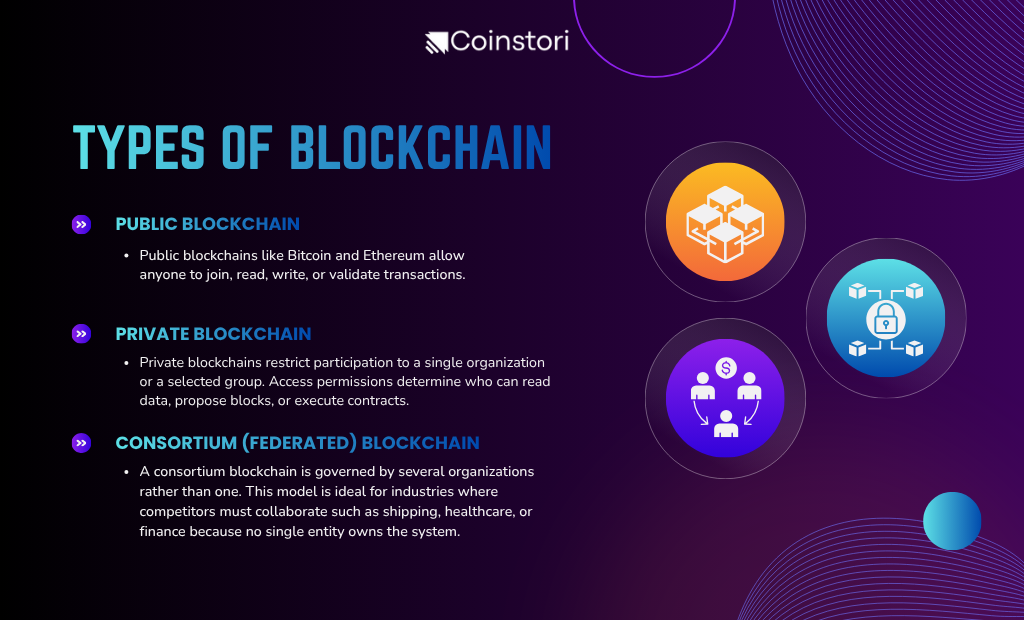
Decide whether your use case fits a public, private, consortium, or hybrid network.
Public blockchains maximize transparency and decentralization, while private and consortium networks give you more control, performance, and privacy.
Hybrid models let you keep sensitive data off-chain while anchoring proofs and key events on a public chain for verifiability.
A successful roadmap involves assessing the need for a shared ledger, selecting the appropriate network type—public, private, or consortium—and conducting rigorous essential features of blockchain audits on smart contract logic.
Select a blockchain platform aligned with your domain
Each platform has its strengths: Ethereum is ideal for public smart contracts and DeFi-style logic, Corda is built for financial institutions that need privacy and legal finality, and Hyperledger Fabric is often used in supply chains, trade finance, and enterprise consortia.
Evaluate performance, tooling, ecosystem maturity, and compliance requirements before committing.
Choosing the right consensus algorithm is vital for performance.
Step 04
Design logic
Design clear, precise smart contract logic
Translate your business rules into smart contracts that are simple, explicit, and predictable.
Avoid unnecessary complexity, define edge cases up front, and document assumptions clearly.
Remember that once deployed, smart contracts are hard or impossible to modify, so invest time in getting the logic and governance model right from the beginning.
Integration with legacy systems remains a significant technical hurdle.
Step 05
Audit & harden
Audit for security before going live
Security must never be an afterthought.
Have independent experts review your smart contracts, access controls, and key-management strategy.
Run testnet simulations, penetration tests, and fuzzing if possible.
A single overlooked vulnerability can lead to financial loss, data exposure, or permanent damage to stakeholder trust.
Regulatory compliance must be baked into the protocol design.
Integrate blockchain with existing systems
Blockchain should enhance your current tech stack, not replace everything overnight.
Connect it to ERP, CRM, logistics, and banking systems via APIs or middleware so on-chain events can trigger off-chain actions and vice versa.
Focus on seamless user experiences where most people interact with familiar interfaces while blockchain runs quietly in the background.
Data privacy laws like GDPR require careful consideration.
Deploy a pilot, learn fast, and scale gradually
Start with a focused pilot involving a limited set of partners and a clearly defined success metric.
Use this phase to test performance, governance, operations, and user experience in the real world.
Once the model proves its value, expand the network, onboard more participants, and evolve toward a full-scale ecosystem that becomes a core part of your digital infrastructure.
The future convergence with AI
The intersection of blockchain and artificial intelligence represents the next frontier of digital evolution. AWS By providing an immutable trail for AI training data and enabling autonomous agents to interact via smart contracts, blockchain creates a trust layer for the AI-driven economy. Google Cloud As we look toward the future, the integration of these technologies will likely redefine how we manage digital identity and blockchain reshaping global cooperation. AWS We are moving toward an era of verifiable intelligence where data integrity is guaranteed by code rather than human oversight, ensuring a more secure digital future for all participants who rely on transparent and decentralized systems. Google Cloud


