



Investors seeking to navigate the intersection of DeFi and DePIN must prioritize verifiable data over speculative marketing. By analyzing hardware transparency, revenue sources, and tokenomics alignment, participants can distinguish between sustainable infrastructure projects and those reliant on temporary incentives.
Hardware utilization transparency in DePIN networks
Evaluating the legitimacy of a Decentralized Physical Infrastructure Network (DePIN) requires moving beyond marketing claims to verify that physical hardware is actively contributing to network capacity. Investors must demand proof that the infrastructure is operational rather than merely a theoretical promise of future utility.
Proof of physical work verification
Reliable protocols implement cryptographic proofs of physical work, such as Proof of Coverage (PoC) used by Helium or Proof of Spacetime in storage networks. These mechanisms ensure that node operators are providing verifiable services, like wireless coverage or data storage, rather than spoofing data to claim rewards. A transparent project will provide a public dashboard showing real-time node activity, latency metrics, and geographic distribution of active hardware.
Hardware depreciation and maintenance cycles
Physical assets inevitably degrade, impacting the long-term viability of the network. A sustainable DePIN project accounts for hardware replacement costs within its tokenomics. Examine whether the protocol provides clear documentation on the expected lifespan of the hardware units and if the incentive structure allows operators to recover the cost of equipment upgrades over time.
Liquidity and yield sustainability in DeFi and DePIN models
The convergence of defi and depin creates complex financial structures where yields must be scrutinized to determine if they are backed by genuine service revenue. Understanding the elements of DeFi DEX models is essential here, as protocols that rely solely on inflationary token emissions to attract liquidity often face a “death spiral” once the initial incentive pool depletes.
Revenue source decomposition
Genuine yield originates from end-users paying for services, such as bandwidth, computing power, or storage. Analyze the protocol’s treasury to identify the ratio of revenue generated from real-world customers versus liquidity mining rewards. A healthy model demonstrates a growing percentage of revenue derived from external service fees, indicating true product-market fit.
Key evaluation metrics for infrastructure protocols
- Network Utilization Rate: Percentage of active hardware capacity currently serving real-world demand.
- Revenue-to-Emission Ratio: The proportion of protocol income from service fees versus token inflation.
- Hardware ROI Period: Estimated time for a node operator to break even on equipment costs.
- Oracle Decentralization Score: Number of independent nodes feeding physical data to the blockchain.
Analyzing the burn-and-mint equilibrium
A robust model often employs a Burn-and-Mint Equilibrium (BME) to link token value to network usage. In this structure, users pay for services in fiat or a stablecoin, which is then used to burn tokens or buy them back from the market, while node operators are rewarded with newly minted tokens. This creates a direct correlation between service demand and token scarcity. Investors should check if the protocol’s burn rate is transparently tracked on-chain, as this provides a clear indicator of actual network adoption versus artificial volume.
Tokenomics alignment between physical supply and financial demand
Token value accrual should correlate directly with the utilization of the physical network. If the token price increases while network usage remains stagnant, the project is likely driven by speculation rather than utility. Effective incentive models reward node operators for quality of service, such as high uptime and low latency, rather than just raw participation. Review the protocol’s slashing mechanisms; if an operator faces no financial penalty for poor performance, the network is prone to low-quality service that drives away enterprise customers.
Assessing the hardware-to-token feedback loop
A critical, often overlooked metric is the hardware-to-token ratio. In a healthy ecosystem, the cost of deploying hardware should be lower than the expected discounted cash flow generated by the network services over the hardware’s lifespan. If the cost of hardware is significantly higher than the potential yield, the network will struggle to attract organic, non-speculative participants. Investors should look for protocols that offer hardware leasing or financing options, as these lower the barrier to entry and increase the likelihood of a diverse, decentralized node operator base.
Governance and centralization risks in hybrid protocols
The bridge between physical hardware and on-chain finance often introduces single points of failure, particularly in how data is transmitted to smart contracts. Centralized control over the data pipeline can undermine the entire premise of decentralization. Look for projects that utilize decentralized oracle networks like Chainlink or custom multi-signature verification processes to ensure data integrity.
Regulatory compliance and physical asset custody
Holding tokens tied to physical hardware introduces unique legal considerations, especially regarding the classification of the token as a security. Investors must assess whether the protocol provides clear legal frameworks for node operators and token holders. Protocols that operate globally must account for local data privacy laws and hardware import regulations. A transparent project will explicitly outline the legal responsibilities of node operators in different jurisdictions to mitigate the risk of sudden network shutdowns.
Frequently Asked Questions
Distinctions between DePIN and traditional infrastructure
DePIN uses token incentives to crowdsource the deployment and maintenance of physical infrastructure, whereas traditional infrastructure is typically built and managed by centralized corporations.
Mechanisms for earning rewards in a DePIN network
Users earn rewards by providing physical resources like bandwidth, storage, or computing power, which are verified on-chain through proofs of work or coverage.
Primary risk factors associated with DePIN projects
Key risks include hardware depreciation, reliance on centralized oracles for data integrity, regulatory uncertainty, and tokenomics that rely on unsustainable inflation. These risks are often highlighted when disrupting finance with DeFi, as the integration of real-world assets requires rigorous oversight.
Clarification on DePIN versus decentralized cloud storage
Decentralized cloud storage is a specific subset of DePIN; DePIN is a broader category that includes wireless networks, sensor grids, and energy distribution.
Operational mechanics of the DePIN flywheel effect
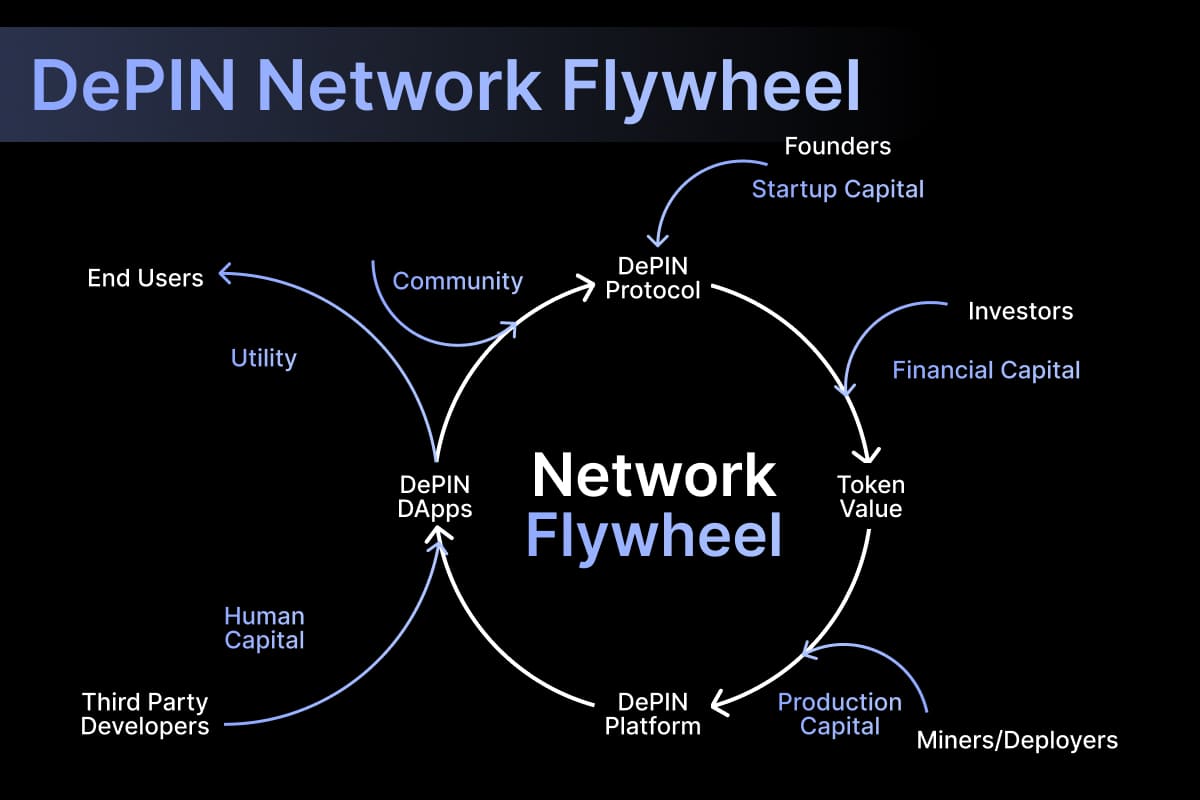
The flywheel occurs when token incentives attract more hardware providers, increasing network utility, which attracts more users, subsequently increasing token value and further incentivizing providers.
Role of DePIN as a connectivity layer
DePIN acts as a connector by bridging the gap between physical-world assets and digital financial markets, allowing decentralized finance protocols to interact with real-world infrastructure.


