When business teams ask how to build a dapp for business, they often assume the hardest part is technology.
In reality, technology is rarely the bottleneck.
Most failed DApp initiatives collapse because:
- The business problem was unclear
- Decentralization was treated as a feature, not a strategy
- Success metrics were borrowed from Web2
- Teams underestimated the human element: trust, incentives, and behavior
A DApp is not just software. It is a public system of rules, deployed on a shared infrastructure, with real economic consequences.
This article provides a non-technical, business-first roadmap helping leadership, product owners, and strategy teams move from idea to mainnet with clarity and confidence.
If your team is still aligning on the fundamentals of blockchain itself, it is strongly recommended to review what blockchain technology is and why it matters before proceeding.
Part 1: Start with the business problem, not the DApp idea
The first mistake business teams make is starting with “We should build a DApp”.
The correct starting point is:
- Where does trust currently fail?
- Which intermediaries create friction or cost?
- What data or transactions must be verifiable by all parties?
If your problem can be solved with:
- A centralized database
- Internal process changes
- Standard APIs
Then a DApp is likely unnecessary.
Understanding the broader shift from centralized platforms to user-owned systems is essential here. Many teams clarify their direction only after revisiting what Web3 actually means for businesses and how it reshapes ownership and accountability.
Business takeaway: A DApp should exist because decentralization removes friction — not because it sounds innovative.
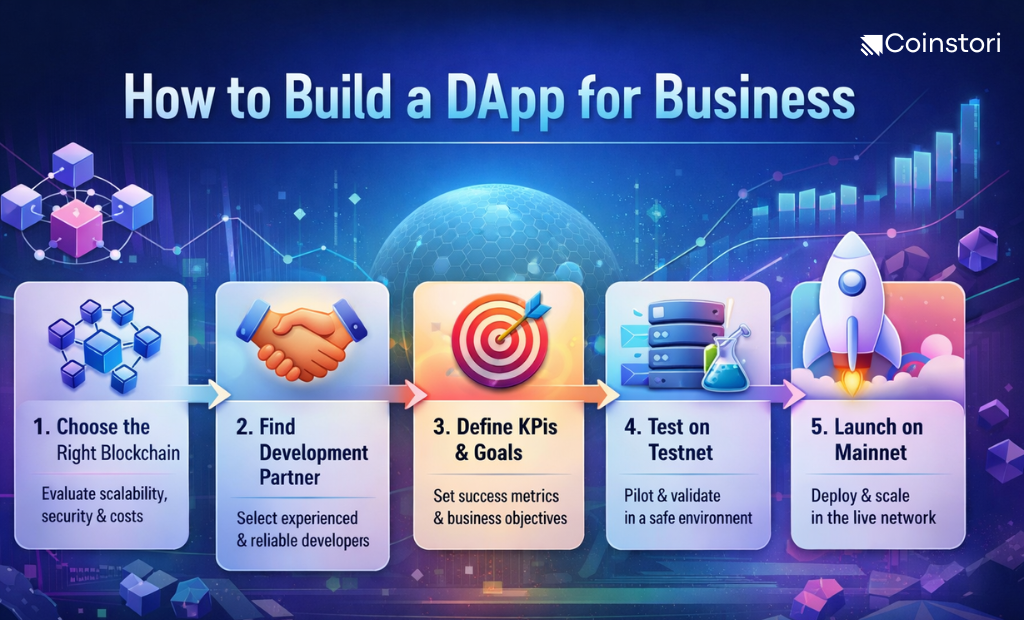
Part 2: Decide whether smart contracts are truly required
Every DApp relies on smart contracts, but not every business model should.
A smart contract is:
- Immutable once deployed (or difficult to change)
- Publicly auditable
- Executed exactly as written, without discretion
This creates both power and risk.
Before committing, business teams must clearly understand what smart contracts are and ask:
- What value is locked on-chain?
- Who bears the risk if logic fails?
- How are upgrades governed?
If your business model requires frequent rule changes, manual exceptions, or subjective decisions, smart contracts may constrain you rather than empower you.
Part 3: Choose the right blockchain from a business lens
Blockchain selection is not a popularity contest. It is a strategic infrastructure decision.
Key business-level criteria include:
- Transaction cost predictability
- Network reliability and security history
- Ecosystem maturity (wallets, tooling, users)
- Regulatory perception in your target markets
Many teams struggle here because they conflate Bitcoin, blockchain, and Web3. Clarifying the distinction early helps prevent costly misalignment → Blockchain vs Bitcoin vs Web3: what’s the difference?
Business takeaway: Your chain choice directly impacts user experience, costs, and long-term scalability.
Part 4: Partner with developers as strategic collaborators
Your development partner is not just a vendor. They shape:
- Architecture decisions
- Security assumptions
- Upgrade paths
- Time-to-market realism
When evaluating partners, look beyond technical skill:
- Can they explain trade-offs in business terms?
- Do they challenge weak assumptions?
- Have they supported products post-mainnet?
A strong partner educates your internal team, helping them become confident owners of the product — not passive observers.
Part 5: Define KPIs that reflect decentralized reality
Traditional product KPIs often fail in Web3 environments.
Avoid focusing solely on:
- Raw transaction counts
- Wallet connections
- Token price movements
Instead, prioritize:
- Active wallet retention
- Cost per meaningful on-chain action
- Value secured by smart contracts
- Governance participation (if applicable)
- Revenue sustainability independent of speculation
For financial or asset-based DApps, understanding how blockchain finance has evolved beyond simple payments is crucial → From crypto payments to tokenized assets
Part 6: Treat testnet as a rehearsal, not a formality
Testnet is where assumptions are exposed.
Business teams should use this phase to validate:
- Real user behavior
- Economic incentives
- Fee sensitivity
- Failure and edge cases
If your DApp interacts with exchanges, liquidity, or user onboarding via trading platforms, understanding how crypto exchanges function will help align UX and expectations before mainnet launch.
Treat testnet as a rehearsal, not a formality
In how to build a dapp for business, testnet is the stage where assumptions are exposed—before real users and real value are on the line.
Validate real user behavior
Observe how users actually move through flows (connect wallet → sign → confirm). Track drop-offs, confusion points, and time-to-complete—then simplify UX before mainnet.
- Session recordings / funnel steps (non-sensitive)
- Friction hotspots: signature prompts, approvals, gas prompts
- First-use → second-use conversion
Stress-test economic incentives
Test whether incentives drive the right behaviors. Simulate abuse, farming, and edge strategies. Validate that rewards, fees, and limits create sustainable usage—not short-term spikes.
- Sybil / spam scenarios
- Reward loops: retention vs. exploitation
- Policy guardrails: caps, cooldowns, allowlists
Measure fee sensitivity (gas UX)
Fees are part of the product experience. Validate whether users understand costs, when they abandon, and how different network conditions impact completion.
- Cost clarity: pre-estimates and confirmations
- Retry behavior under congestion
- Fee thresholds that break conversion
Drill failure and edge cases
Test what happens when things go wrong: rejected signatures, reverted transactions, RPC downtime, partial confirmations. Build graceful recovery and clear messaging.
- Reverts, timeouts, nonce issues
- Wallet rejection and multi-click errors
- Rollback plans and incident playbooks
Align onboarding with exchanges & liquidity flows
If your DApp depends on trading platforms, liquidity, or fiat→crypto onboarding, validate assumptions early so expectations match reality before mainnet.
Part 7: Mainnet is the beginning of accountability
Launching on mainnet is not a finish line. It is a commitment.
Once deployed:
- Rules are public
- Mistakes are permanent
- Trust is earned through consistency, not messaging
Post-launch focus should include:
- Monitoring and transparency
- Ongoing security reviews
- Governance evolution
- Clear communication with users and stakeholders
In decentralized systems, credibility compounds — but so do errors.
Conclusion: How to build a DApp for business the right way
Learning how to build a dapp for business is ultimately about mindset, not code.
Successful business-led DApps share common traits:
- Clear problem-solution fit
- Respect for decentralization’s constraints
- Measurable value beyond hype
- Long-term trust as a core asset
When business teams treat blockchain as infrastructure not marketing DApps stop being experiments and start becoming durable systems.
FAQ: How to build a DApp for business
Practical answers for business teams: choose a chain, work with dev partners, define KPIs, and move from testnet to mainnet.